

Buffalo Bill turned frontier grit into global showmanship
In The Undiscovered Country, historian Paul Andrew Hutton uses seven very different individuals to frame the story of the American West. One of these, William F. Cody, aka Buffalo Bill, was a particularly interesting blend of the authentic and the fictional.
Born in 1846 in Iowa to a Canadian father and an American mother, the young Cody was just 11 years old when his father died. With money being tight, it was soon time to go to work.
At the age of 14, he became a Pony Express rider, joining a new company with an eye-catching recruitment ad: “Young skinny wiry fellows not over eighteen. Must be expert riders willing to risk death daily. Orphans preferred.”
The sobriquet Buffalo Bill derived from a relatively brief stint as a buffalo hunter. Contracted by Goddard Brothers to provide meat for workers building the Kansas Pacific Railway, Cody killed 4,280 buffalo between October 1867 and May 1868. As Hutton notes, Cody hunted on horseback in the same personally dangerous way that Native American tribes did. His modus operandi bore no relation to the subsequent “great slaughter,” which operated on an industrial scale characterized by shooting from behind protective stands.
Next up was a spell as chief of scouts for the 5th Cavalry, during which Cody saw lots of action, was wounded, and eventually received the Medal of Honor. In the process, he became the army’s most famous scout. He also developed an influential sponsor in the form of General Phil Sheridan, one of the major military figures to emerge from the Civil War.
Meanwhile, along came Ned Buntline, the master of the dime novel. In 1869, Buntline published the fictional first installment of Buffalo Bill, the King of the Border Men, and things took off from there. Hutton describes it as initiating the legend of “a frontier Hercules to match Boone, Crockett and Carson.” After meeting Buntline during an 1872 visit to New York City, Cody found himself besieged with letters promising fame and fortune if he’d “come east and portray himself on the stage.”
As Buffalo Bill, Cody trod the boards in the stage production of Buntline’s The Scouts of the Prairie, opening in Chicago on December 18, 1872. Although it “had no discernible plot, which was fine, since Cody forgot all his lines anyway,” the show was a box-office hit. There was some more scouting after the tour ended in June 1873, but his future path was clear.
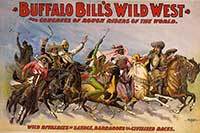
By the early 1880s, Cody was ready to expand beyond theatrical tours. In collaboration with impresario Nate Salsbury, Buffalo Bill’s Wild West was launched for the 1884 season. The scale of the production was much bigger than the previous theatrical endeavours. Playing arenas in an extravaganza conceived along the lines of a historical pageant, it presented the winning of the West through American eyes.
Cody was shrewd enough to build the box office by sharing the spotlight. It wasn’t a question of lacking personal confidence or ego, but rather a demonstration of the showman’s instinctual feel for the attraction of spectacle, notoriety and novelty. Above all, he kept the customers satisfied.
For instance, less than 10 years after Custer’s annihilation at the Little Bighorn, Cody signed Sitting Bull—Custer’s Lakota Sioux nemesis—for a four-month summer 1885 tour of the U.S. and Canada. In addition to a signing bonus and a weekly salary, Sitting Bull was granted exclusive rights to the ancillary revenue from portraits and autographs. The advertising pushed the theme of “Foes in ’76, Friends in ’85,” accompanied by a side-by-side photo of the two men.
Two years later, Buffalo Bill’s Wild West took London by storm. Opening to the general public on May 9, 1887, the show played to massive audiences during its five-month run. Queen Victoria herself saw it twice, joined the second time by a host of European royalty, including the future Kaiser Wilhelm II and the kings of Belgium, Greece, Denmark and Saxony.
The ensemble that set sail for London was impressive. There were 218 people (including 97 Lakota Sioux), 180 horses, 18 buffalo, 10 elk, five steers, four donkeys and a couple of deer. Along with exhibitions of marksmanship, riding and roping, there was “a buffalo hunt with real buffalo, a Sioux attack on the Deadwood stage, a Pony Express ride, and at the climax, a tableau presentation of Custer’s Last Stand in which some Lakota who had actually fought in the battle took part.”
Appetite whetted by the 1887 success, the show crossed the Atlantic seven more times between 1889 and 1906, travelling the length and breadth of Britain, and playing all over Europe, including France, Spain, Italy, Austria-Hungary, Germany, the Balkans and Poland.
Hutton has a nuanced bottom line on Buffalo Bill: “He was, like the nation he came to symbolize, a bundle of contradictions: a hunter who became a conservationist; a friend to Indians who was famed as an Indian fighter; a rugged frontier scout best remembered as a sequined showman … Cody lived the Wild West from 1846 to 1876, then he took it on the road, first in stage shows and then in the greatest arena extravaganza of all time.”
A perfect example of reality blending into mythology.
Troy Media columnist Pat Murphy casts a history buff’s eye at the goings-on in our world. Never cynical – well, perhaps a little bit.
Explore more on History, Legends, Non-fiction books, History books
The views, opinions, and positions expressed by our columnists and contributors are solely their own and do not necessarily reflect those of our publication.
Troy Media empowers Canadian community news outlets by providing independent, insightful analysis and commentary. Our mission is to support local media in helping Canadians stay informed and engaged by delivering reliable content that strengthens community connections and deepens understanding across the country.

0 Comments