
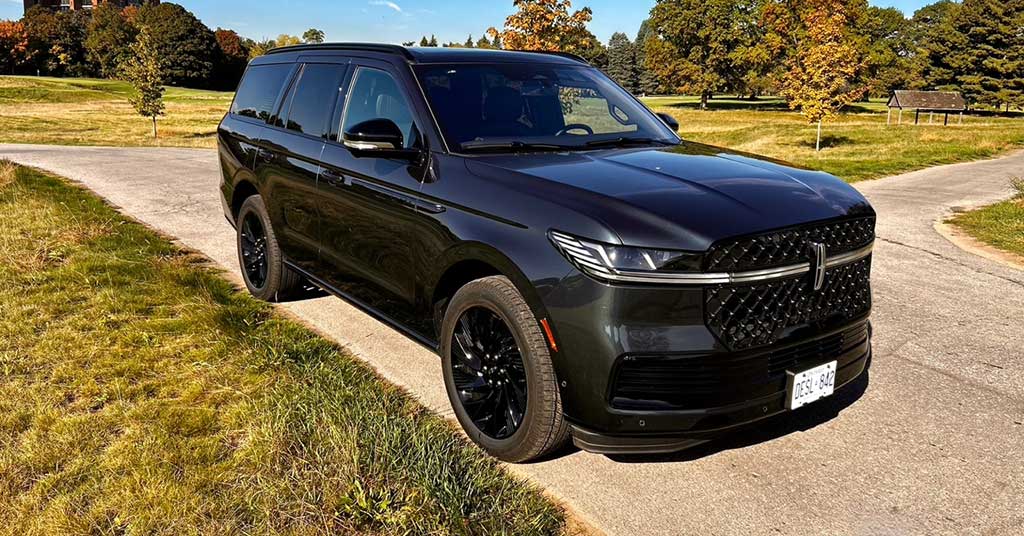
Lincoln dropped its sedans after the 2020 model year but refused to shrink its idea of luxury

The Navigator L combines scale, towing strength and quiet refinement in one package.

Lincoln may have abandoned sedans, but it hasn’t abandoned luxury. The Navigator L is now the brand’s flagship, carrying Lincoln comfort and presence into the SUV era.
Lincoln, Ford’s luxury vehicle division, built its reputation on large luxury cars such as the Continental. When it discontinued its last sedan after the 2020 model year and shifted entirely to SUVs, it concentrated that identity in vehicles like this one.
The largest and most expensive Lincoln now wears the Navigator L badge, competing with vehicles such as the Cadillac Escalade, Jeep Grand Wagoneer and Lexus LX. I recently test drove one, and it’s clear this SUV isn’t about mud bogs or backwoods trails. It’s about quiet comfort, space and authority on the road.
The total price tag on my tester, one of the largest vehicles on the market, was $134,465. The wheelbase is 3,111 mm, overall length is 5,333 mm, it’s 2,404 mm wide and 1,980 mm high. Towing capacity is 8,700 pounds. Those dimensions reinforce what this SUV is built for: space, comfort and presence rather than sporty performance. Buyers who tow large boats or trailers will appreciate that capacity, and with four-wheel drive standard in Canada, the Navigator L is equipped for year-round use.

Inside, the emphasis shifts to calm. The panoramic screen stretches completely across the top of the dashboard. It’s easy to get used to and makes it simple to find information at a glance. For example, the current weather is displayed right in front of the passenger. And it’s not just a number; there’s room to display a graphic of current weather conditions. The wide display reduces visual clutter.
From the driver’s seat, there’s a clear sense of space. Large windows and oversized rearview mirrors enhance visibility. Despite its size, surround-view cameras and driver-assistance systems make parking and low-speed manoeuvring manageable in tight urban spaces and garages.
There’s room for eight people in the Navigator: two up front in the bucket seats, and two more rows behind that can each accommodate three people comfortably. Cargo space measures 592 litres behind the third row and increases to 2,947 litres when the second and third rows are folded.
The seats provide plenty of pampering. The leather surfaces have strong side bolsters, power massagers, and can be heated or cooled. The front edge of the driver’s seat cushion—the part under your thighs—is also divided into two separate padded sections that move independently using power controls. One side can extend slightly farther forward than the other, allowing taller drivers to stretch one leg straight while keeping the other bent to work the pedals. It’s one of those details that sounds unnecessary until you use it.
Power comes from a twin-turbocharged 3.5-litre V-6 engine producing 440 hp and 510 lb.-ft. of torque. Fuel consumption is rated at 15.6 litres per 100 kilometres in the city and 10.8 litres per 100 kilometres on the highway. Those figures are typical for a full-size luxury SUV of this size and weight.
On the road, acceleration is strong for a vehicle weighing more than 2,700 kilograms. The twin-turbo engine delivers power smoothly, and the 10-speed automatic transmission shifts unobtrusively. At highway speeds, road and wind noise are well suppressed, and the suspension isolates passengers from rough pavement.
That smooth, quiet ride is paired with a few deliberate nods to automotive history.
- There’s a push-button transmission. The buttons in the lower section of the centre dashboard make selecting a gear easy—no twisting, turning or pulling on a lever—while freeing up console space. Chrysler used push-button transmissions from 1956 to 1964, and others followed. Lincoln revived the concept on the 2018 Navigator.
- The steering wheel is flattened on the top and bottom, providing extra leg room and clearer gauge visibility. The idea originated in racing, and Chrysler used similar wheels in the 1960s.
- The two-piece tailgate—bottom half down, top half up–recalls station wagons of the 1950s. It’s a contemporary interpretation of a classic solution.
For buyers who want space for a large family, the ability to tow heavy loads and a quiet, well-insulated cabin, the Navigator L delivers. Lincoln no longer builds sedans, but it still builds vehicles that put comfort first.
Our Verdict:
The Lincoln Navigator L delivers exactly what it promises: size, comfort and quiet authority. It isn’t built for sporty driving or fuel savings, but for buyers who want space, towing strength and a calm, well-insulated cabin. It stands as one of the most imposing and refined SUVs on the road.
Dale Johnson is an award-winning author, broadcaster and journalist who has worked in TV, radio, print and online. While the manufacturer provided Dale with a vehicle to test drive, the content of this review was not reviewed or accepted by the manufacturer.
Explore more on 2025 car review, Luxury cars, Ford
The views, opinions, and positions expressed by our columnists and contributors are solely their own and do not necessarily reflect those of our publication.
Troy Media empowers Canadian community news outlets by providing independent, insightful analysis and commentary. Our mission is to support local media in helping Canadians stay informed and engaged by delivering reliable content that strengthens community connections and deepens understanding across the country.

