
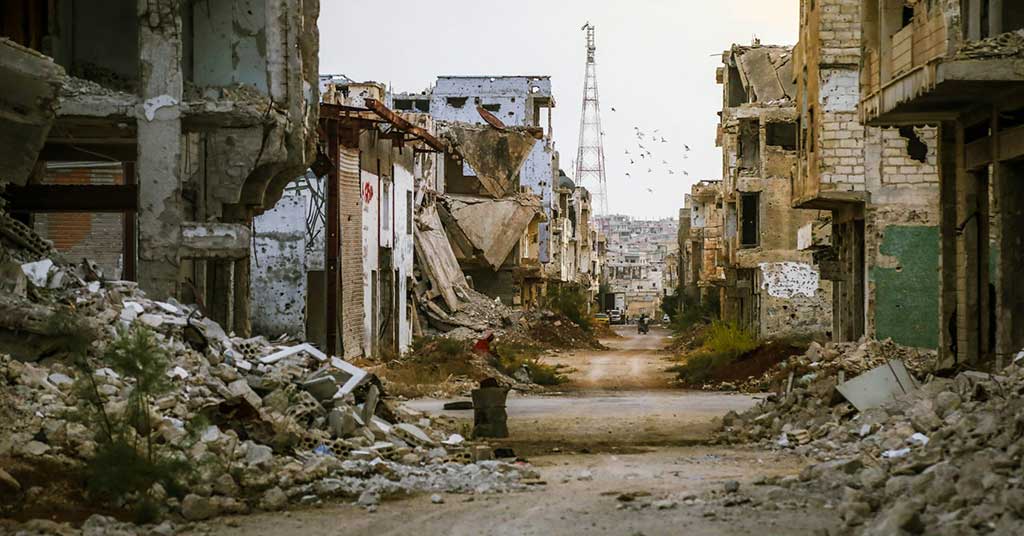
Christians and Druze in Syria say violence and intimidation continue while Ottawa treats Damascus like a success story
Ottawa is giving Syria’s new government the benefit of the doubt even as Christians, Alawites and Druze report massacres, intimidation and humanitarian collapse across the country.
Canadian ambassador Gregory Galligan recently gave the post-Assad government led by Ahmed al-Sharaa a passing grade during testimony before the House of Commons Standing Committee on Foreign Affairs and International Trade.
When MPs Ziad Aboultaif and Rob Oliphant pressed him on the status of minorities in Syria, Galligan offered a cautiously optimistic assessment. He also defended the removal of sanctions that were in place until the fall of Bashar Assad in 2024, when Western governments began cautiously reopening diplomatic engagement with Syria’s new leadership.
“They (the Al-Sharaa government) listen to our concerns about representation of women and minorities,” he said, adding that Canada is actively “issuing grants to women’s groups and those advancing a democratic vision for Syria, measures which would not have been possible under the previous sanctions.”
But Christian, Alawite and Druze activists, as well as observers on the ground, say Galligan’s testimony seriously downplayed the fear, uncertainty and sheer terror of extremist attacks these communities face on a day-to-day basis. Many remain skeptical because of Al-Sharaa’s past as the leader of HTS (Hayat Tahrir al Sham), an Islamist faction formerly linked to al-Qaeda and designated as a terrorist organization by several Western governments.
“Our partners on the ground inform us that Christian families are living in fear, and there is no stability or security for them in Syria, driving many of them to leave their homeland,” said Nagui Demian, international programs coordinator with Development and Peace-Caritas Canada (D&P), the Canadian bishops’ development agency that works with partners on the ground, Caritas Syria and Jesuit Refugee Services (JRS).
“The humanitarian needs are enormous, especially as thousands of Syrians are now returning from Lebanon and the regional conflict involving Iran is spilling over into Syria.”
Witnesses contend that the violence against minorities is relentless despite Al-Sharaa’s assurances that HTS’s extremist past is behind him and that Syria’s new leadership has turned over a new leaf.
But those assurances are colliding with events on the ground, particularly among minority communities that fear reprisals under Sunni Islamist rule after years of sectarian violence during Syria’s civil war.
Two major waves of violence in 2025 devastated Alawite and Druze communities. In March, 1,400 Alawites were killed in coastal areas including Latakia, while in July Druze activists and local monitors reported that 17,000 Druze lost their lives and 200,000 were displaced in the Suweida area.
To Syria’s minorities, these are not isolated incidents but evidence that they remain dangerously exposed despite diplomatic claims of reform.
Nuri Kino, a Swedish journalist and leader of the humanitarian and advocacy organization A Demand for Action, has had extensive experience in political advocacy as well as coordinating humanitarian aid in Syria. He has been monitoring the human rights situation of the country’s sharply reduced Christian population—from 1.5 million before 2011 to fewer than 300,000 at present.
Kino spoke of an alarming incident: a foiled bomb plot at a Christian funeral in Aleppo on May 13.
“We are deeply concerned and outraged,” he said. “We called our contacts in Syria immediately and spoke to two witnesses to the incident. Now we can only thank Our Lord that the bomb did not detonate.”
This is one of several incidents of threats, intimidation and violence against Christians and other minorities that have taken place in recent months, according to survivors and witnesses.
Sara Abbas, a Canadian Syrian Alawite activist based in Regina, Sask., is co-founder and vice-president of the Western Syria Alliance. She questioned Galligan’s testimony to the Commons committee.
“We (the Alawite community) are surprised by the ambassador’s excuses for the jihadist government in Damascus, when the reality is that there are ongoing human rights abuses of minorities,” Abbas said. “If the ambassador had made a simple visit to the coast (of Syria) and met people there, away from the eyes of government authorities, he would have discovered the truth of the massacres, the arbitrary arrests, the kidnapping of women and the denial of their cultural, economic and religious rights.”
Sana Barouki, a Druze activist based in Vancouver, also had strong words of criticism for Galligan’s testimony.
“It is both ridiculous and tragic, what the ambassador told the committee,” Barouki said. “The situation for minorities continues to deteriorate. The Druze remain under siege, and 36 villages abandoned by their inhabitants are still under the control of the government in Damascus, which is preventing people from returning to their homes.”
Barouki echoed Demian’s comments about the urgent humanitarian needs.
“The health care situation is catastrophic,” she said. “There is no access to dialysis or cancer treatment. And the tragedy is not limited to Alawite and Druze regions. Girls are reportedly being kidnapped and sold into slavery. Even in Damascus, the situation is devastating, with soaring electricity prices, widespread disease and the collapse of basic services.”
To many Syrian minorities, these accounts are proof that Western governments are normalizing relations with Damascus while ignoring what is happening on the ground.
Local churches and international charities such as Aid to the Church in Need and D&P are working on the ground with partners to provide material aid.
“We are working with JRS to meet health-care needs and running three clinics in Aleppo,” Demian said. “We also work with Caritas Syria on food assistance, health care and education for children. We also run social cohesion projects.”
He said this is done despite reduced funding from the Canadian government.
“Currently, all our funds come from private (mostly Catholic) donors,” he said. “We are waiting to see if the government will call for project proposals seeking financial support.”
Much of that humanitarian work now depends on private donors despite growing international recognition of Syria’s new government.
International advocacy efforts are led by non-governmental organizations with a global reach, such as A Demand for Action and In Defence of Christians. A coalition of Canadian Syrians, including Alawites, Druze and Christians, has been lobbying the Canadian government, which has committed over $100 million in development aid to Syria, to demand human rights protection for minorities from the Al-Sharaa regime.
In a written submission to the Commons committee on foreign affairs and international trade, the Canadian coalition expressed deep concern about Galligan’s statements.
“We express our deep concern regarding the assessments presented by Canadian ambassador Gregory Galligan to the March 24, 2026, meeting of the Standing Committee on International Development and Trade. In our view, he significantly minimized the scale and nature of the atrocities committed against minority communities. His statements were entirely based on the narrative of the Syrian government,” they wrote.
The coalition urged the Canadian government to support impartial international investigations into the ongoing massacres and sectarian crimes in Syria, to engage directly with independent civil society organizations, survivors and victims’ families rather than relying exclusively on government narratives, and to make the lifting of sanctions conditional on concrete guarantees and accountability mechanisms for human rights protections for all Syrians.
If the accounts from Syria’s Christians, Alawites and Druze are accurate, then Ottawa is not merely misreading events. It risks helping legitimize a government that minorities themselves say is failing to protect them from sectarian violence, intimidation and displacement.
Kino warned that the entire Syrian Christian community might be forced to leave its ancient homeland unless the international community takes immediate action.
“What’s happening now is ethno-religious cleansing—a slow systematic removal of minorities through fear, violence and dispossession,” he said. “The world must wake up now and demand stronger protection for Syria’s religious and ethnic minorities.”
Susan Korah is Ottawa correspondent for The Catholic Register, a Troy Media Editorial Content Provider Partner.
Explore more on Human Rights, Terrorism, War/Conflict
The views, opinions, and positions expressed by our columnists and contributors are solely their own and do not necessarily reflect those of our publication.
Troy Media empowers Canadian community news outlets by providing independent, insightful analysis and commentary. Our mission is to support local media in helping Canadians stay informed and engaged by delivering reliable content that strengthens community connections and deepens understanding across the country.

